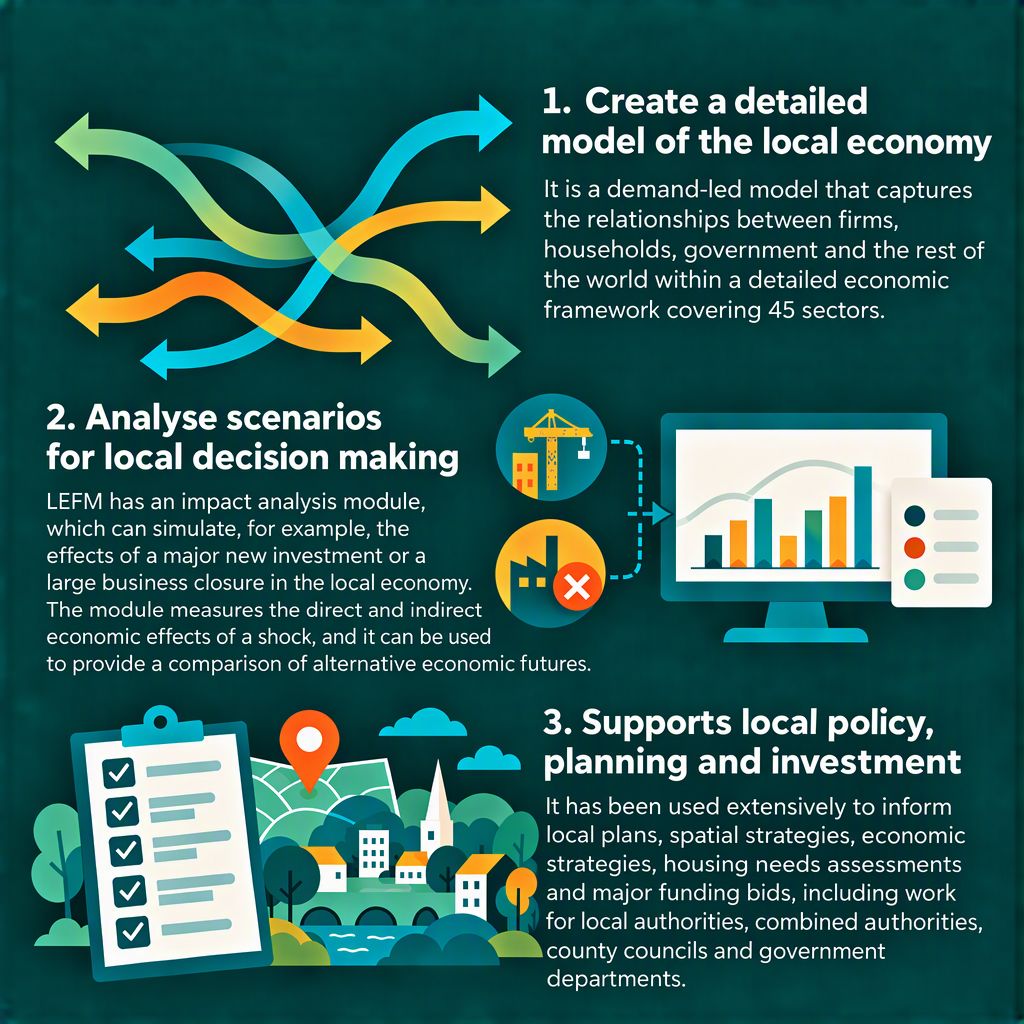
The Local Economy Forecasting Model
A purpose-built model for local economies
The Local Economy Forecasting Model (LEFM) is a purpose-built local area tool for forecasting and assessing economic impacts in the UK. LEFM explains how a local economy functions by analysing expenditure flows between sectors within the local area and their links to the wider economy.
Deeper insight into local economic impacts
Unlike simpler methods that simply scale national trends down to the local level, LEFM can explain why local areas perform differently. It can assess indirect impacts, such as the effects of a business opening or closing, by incorporating local knowledge of how that business operates within the local economy.
Trusted and proven analytical framework
- Developed by Cambridge Econometrics in collaboration with the Institute for Employment Research at the University of Warwick.
- Commercially available since the early 1990s.
- Used extensively by local authorities.
What LEFM helps you do
Developed over decades and refined through extensive project work, LEFM is a core part of how we deliver rigorous local economic analysis.

What sets LEFM apart?
Built around local economic realities
LEFM produces forecasts of key economic and labour market indicators for specific local areas. Unlike other local economy modelling approaches, which typically link local output or employment directly to national or regional performance, LEFM projects economic indicators by modelling expenditure flows within the local area and their links to the wider economy. As a result, it provides insight beyond conventional projections, including the ability to analyse the indirect impacts of economic activity.
Greater sector detail for better forecasts
LEFM is distinguished from other approaches by its sectoral detail. It identifies 45 sectors, allowing, for example, electronics to be distinguished from electrical equipment, and IT services from other business support services. This greater granularity helps analyse opportunities and risks that can be hidden within broader sector classifications.
Detailed historical analysis
LEFM includes local historical data from 1981 onwards, allowing detailed analysis of long-run trends. Examining how a local economy, or a sector within it, performed over a particular period (e.g. during growth or recession) provides useful historical comparisons for developing plausible scenarios and forecasts.
Flexible scenario modelling
There are a number of assumptions in the model that can be changed to take account of local information in order to create an alternative set of projections (scenarios), including:
- sector prospects – gross value-added and productivity
- population – the model will capture demand-side impacts from a change in population
- economic activity rates by age band and gender
- structure of inputs to production
- local supply content – the extent to which the demand for inputs to production will be met from local suppliers