
Insularity: why island policy needs to look beyond island status
9 November 2026
Effective economic development and cohesion policy needs to acknowledge and respond to the geographic specificities of places. For island territories, the defining characteristic is insularity, creating economic costs and barriers from being surrounded by water and disconnected, to varying degrees, from mainland areas. How insularity is understood, whether as a simple fact of being an island or as a broader combination of factors, can determine the policy responses designed to address these disadvantages.
The recent OECD report Policy Pathways Beyond the Shoreline: Enhancing Resilience and Innovation in Island Economies defines insularity narrowly as being an island, while considering other geographic conditions separately. The OECD finds that it is challenging to quantify costs that are associated with island status alone. To understand the costs of insularity, a simple definition won’t suffice.
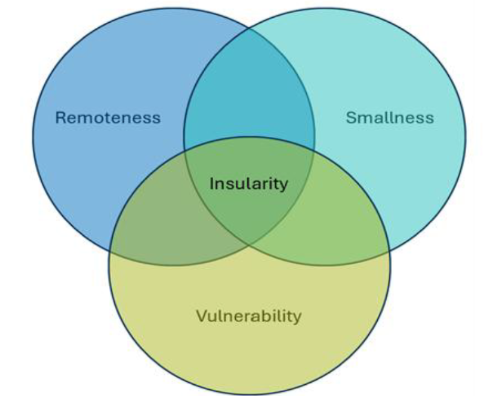
Cambridge Econometrics and E-Cubed take a broader view in their 2026 report for ESPON, The Economic Costs of Malta’s Insularity. Rather than treating insularity as island status alone, the study identifies three conditions that help explain the structural disadvantages of insular places:
- Smallness: a small domestic market, limited land area, or a small population.
- Remoteness: distance from large markets, centres of population, or trading partners.
- Vulnerability: limited natural resources, exposure to environmental shocks, or risks from climate change.
These conditions can create lasting structural disadvantages, but their economic effects are not beyond the reach of policy. Geography may be fixed; the degree of disconnection it creates is not. The useful question is, therefore, not just “Is this place insular?” but “Which combination of conditions is holding it back, and what can policy change?"
 Source: Cambridge Econometrics
Different islands, different constraints
Malta and the UK illustrate why island status is too narrow a definition for insularity. Both are archipelago nations, but their populations, land areas and connections to continental markets differ greatly. London has land transport connections through the Channel Tunnel; Valletta has no equivalent. Grouping the two as islands tells us much less about their economic constraints than examining their scale and connections.
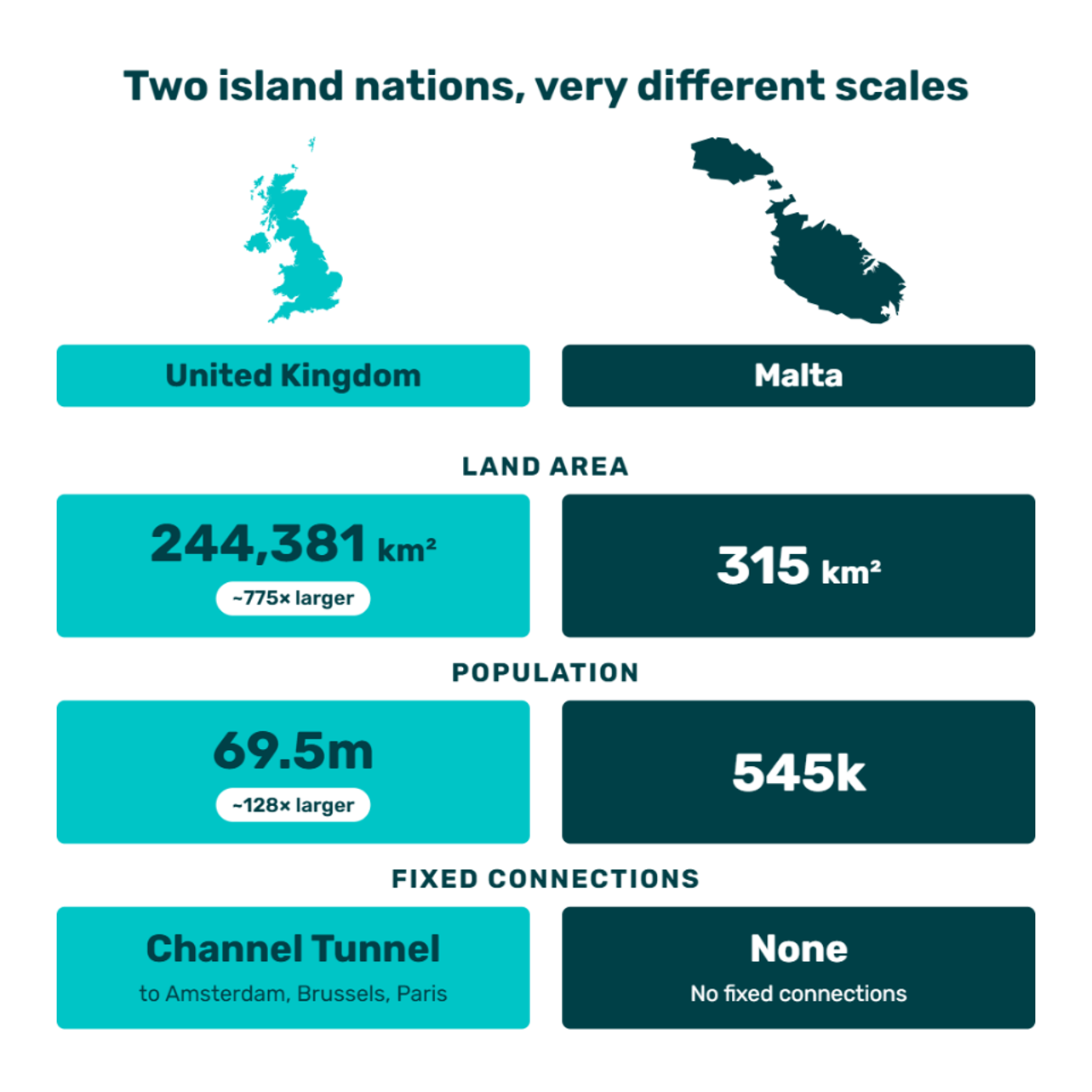 Note: Figure generated with the help of AI tools. Land area and population estimates (for 2025) come from the United Nations.
The same point extends beyond Europe. Large island nations such as Japan and Australia, some of the world’s largest economies, show why island status alone cannot explain economic disadvantage. Scale and connections to global markets matter too. That does not make every part of a large island economy free from insular constraints; it means that broad labels are a poor substitute for examining the conditions facing a particular territory.
For ministries and regional authorities deciding what support to seek, this suggests a practical shift: start with the economic barriers that relate to geographic conditions, then ask how policy could reduce their effects. Certain geographic specificities of island territories offer useful questions:
- What access does the territory have to a mainland? Islands in Greece, Croatia, and Sweden (those covered in the OECD report) have a different territorial context from Malta or Cyprus, which have no continental territory. Illustrative barriers include higher transport costs for island businesses than for mainland competitors, and higher costs of delivering public services across separated territories.
- How well is the island connected? Fixed connections between islands and mainland areas, such as bridges and tunnels, can mitigate the disadvantages of disconnection. For example, Singapore benefits from bridge connections to continental Malaysia, while many islands depend solely on sea or air connections. Illustrative costs for islands without fixed links include the cost of transporting goods to other markets, and the need to organise journeys around available sea or air services.
- How remote is it from the centres that matter? Greenland and other arctic islands illustrate that despite large land areas, disadvantages from remoteness can persist in ‘outermost regions’. A large but remote island territory may still face substantial access constraints to centres of economic activity.
- Are there additional layers of disconnection? Islands faced with ‘double insularity’, such as Gozo, the second largest island in the Maltese archipelago, only have transport connections to mainland areas that run through other islands. Doubly-insular islands confront additional barriers and vulnerabilities, amplifying the impacts of factors such as travel time and transport costs.
Answering these questions, accounting for the geographic specificities of islands, and looking beyond national averages can allow policies to address constraints more flexibly.
Addressing constraints with policy action
What does this mean in practice? Cambridge Econometrics and E-Cubed’s Malta Insularity report recommends specific responses to address economic costs associated with insularity. Selected recommendations for insular territories include:
- Work within land and environmental limits. Align economic strategy with spatial planning, prioritise higher-value, lower-impact tourism and construction, and assess infrastructure against peak demand and future climate risks—not just whether it is available.
- Address gaps in small markets. Use targeted, proportionate interventions where thin markets limit provision or competition. Develop growth-capital financing to help firms move from start-ups to scale-ups.
- Build alternatives into critical networks. Diversify digital links, energy interconnections, and contingency transport options. Back up critical systems and stress-test their ability to maintain services when a major asset fails.
- Design services around inter-island access. Tailor service delivery and contingency planning that accounts for variable access across multi-island territories. Improve ferry coordination and integrated ticketing, and use telemedicine, tele-education, and remote work hubs to reduce travel times where feasible.
- Strengthen capacity in a small administration. Invest in specialist procurement skills, and use joint procurement where it improves efficiency. Support major reforms and investments with systematic evaluation and stronger sharing of evidence across government.
- Make national and supra-national arrangements sensitive to the conditions of insularity. Advocate for funding eligibility criteria, thresholds, and proportionate reporting requirements that reflect the specificities of insular places.
The policy implication is not that every island needs a different policy for its own sake. It is that support should respond to the combination of disadvantages it is intended to address. For officials making the case for EU-level support, or assessing interventions elsewhere, the task is to explain which barriers are structural, how they affect island territories, and realistic potential impacts of policy intervention. Cambridge Econometrics' work on Malta offers a starting point for that discussion.
Get in touch
